
Is Fear Running Your Wellness Business? (Or Have You Built an Expensive Hobby?)
Is Fear Running Your Wellness Business?
(Or Have You Built an Expensive Hobby?)
After years of owning my own massage and acupuncture studio and coaching other wellness providers on how to be successful in their practices, I have come to see a pattern that I think is worth talking about.
I have spent a ton of time and energy putting together courses, 1:1 coaching, and sharing content for free about the things I know are most important to you in the areas of business: getting more clients, keeping clients, setting rates appropriately, and putting supportive systems in place. I love this work, and there is nothing that makes me happier than seeing someone implement what I have shared and start seeing the success they deserve.
But, as much as it pains me to say it, there have been many times that I have worked with a struggling business owner, and it doesn't make the impact that I am hoping for. There can be many reasons for this, but the most common denominator is FEAR.
Fear and lack of skill in particular areas of business are governing factors in many wellness business decisions. It may be hard to hear, but this fear-based mentality and lack of willingness to invest in business skill building are holding us back as a profession and individually.
Here are a few themes I see on repeat:
Fear of bothering clients
Fear of rejection
Fear of being seen as too expensive or unaffordable
Fear that we aren't good enough to charge certain rates or expect clients to return
Fear of what others might think about us
Disbelief that business skills are necessary
Distrust in business leaders in our industry
Relying purely on emotions when it comes to business decisions, instead of data and intellect
I truly believe these fears and lack of business acumen keep us from having the respect in the wellness industry we deserve. And from building sustainable careers in what is currently a $2.1 trillion industry.
Yes, you read that right.
Why Are Wellness Providers Broke in a $2.1 Trillion Industry?
The Wellness Industry Is Huge. We're Barely In It.
Here's something that should make every single wellness provider sit up and pay attention.
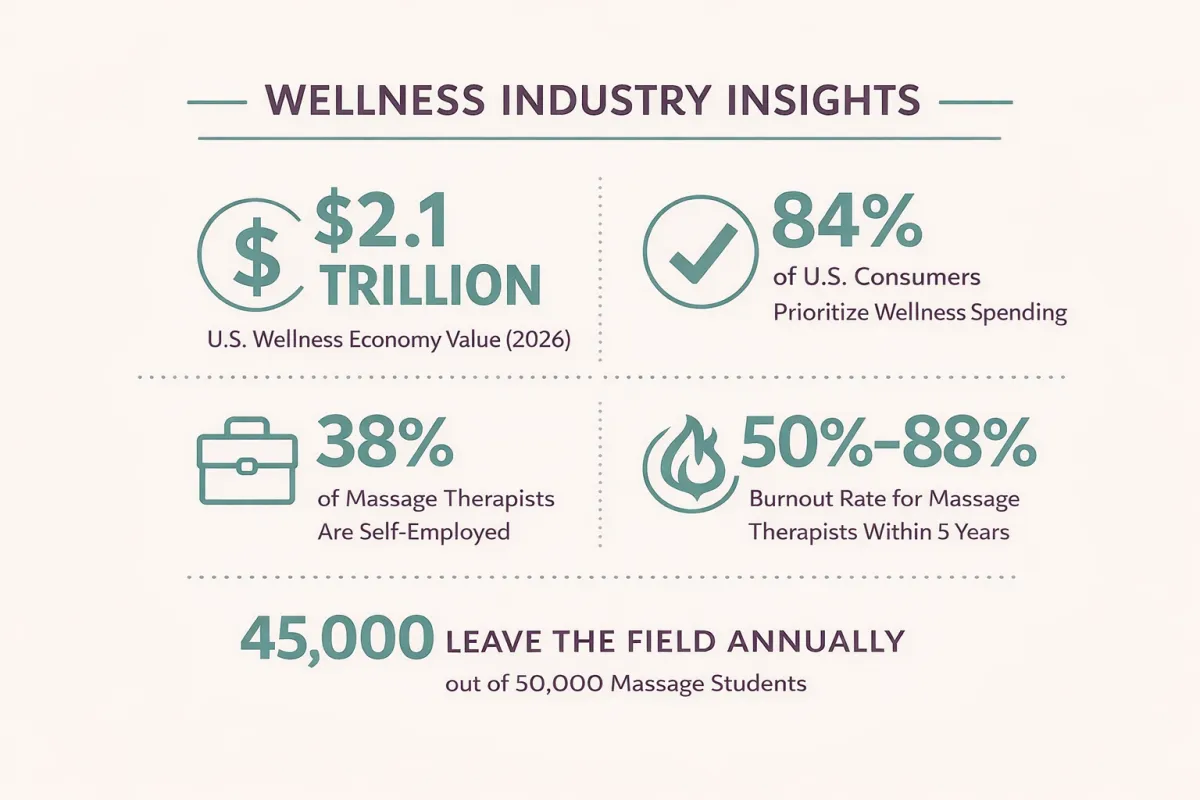
The U.S. wellness economy is valued at approximately $2.1 trillion in 2026. That's roughly one-third of the global wellness market. 84% of U.S. consumers now prioritize wellness spending, and they're treating it as resilient, meaning they'll keep paying for it even when they cut back on luxury or entertainment.
Wellness real estate is booming. Mental wellness is exploding. Wellness tourism is a high-spending sector that keeps growing. Younger generations are driving spending like never before.
Now let's look at the reality for the people actually doing the work.
The median salary for a massage therapist in the U.S. is around $58,000 a year. Sounds decent, until you factor in that the average massage therapist is working only around 26 hours a week because the work is physically demanding. 38% of massage therapists are self-employed, and most of those are sole operators with no systems, no team, and no safety net. The burnout rate in our field has been estimated at 50% to 88% within the first 3 to 5 years after graduation. Of the 50,000 students enrolling in massage schools every year, about 45,000 leave the field annually.
Let that sink in for a second.
We are in one of the fastest-growing, highest-demand industries in the country. And we are leaving it in droves because we can't make it work.
I know massage therapists who can barely afford to feed themselves but whose clients drive Teslas and take international vacations twice a year. I know acupuncturists who are brilliant at what they do, but can't afford to take a week off. I know estheticians with waiting lists who are still paying their bills with a credit card.
Something is wrong here. And it's not the industry. It's not the clients. It's something we are doing to ourselves.
Is This a Business or a Hobby?
I want you to sit with this question for a minute.
There's a real difference between a hobby and a business, and it's bigger than a mindset thing. It's practical. It's financial. And yes, it's also a legal thing from the government's perspective.
Let's start with the practical and financial view.
A hobby business is something you do that you love, and it might earn you some money. But it doesn't fully support you, it doesn't scale, and it doesn't hold space for you to take care of yourself or plan for the future. You're the one absorbing all the risk, all the loss, and all the sacrifice when the income doesn't come in. You might be passionate about it. You might even be the best in town at what you do. But the numbers don't add up to a life you can sustain.
A legitimate business is something that pays you a livable wage, covers its own expenses, has systems in place, and is built to last. It sets prices based on what the owner needs to thrive, not what feels comfortable to charge. It runs like something you'd actually want to invest in, grow, or sell one day. It has policies, boundaries, financial separation between personal and business, and some version of a plan for the future.
Here's where the gap shows up in real life. You're seeing clients. Cash is coming in and going out. Everything looks like a business from the outside. But on the inside: you're not paying yourself consistently, you're underpricing your services, you're grandfathering longtime clients into old rates out of guilt, you don't have a marketing plan, you don't know your numbers, and you may be relying on a partner's income or savings to cover the gaps.
That is a hobby wearing a business costume. And it is exhausting.
What Does the IRS Consider a Business vs. a Hobby?
Now here's where it gets real, because the government has its own take on this, and it matters more than most wellness providers realize.
The IRS looks at several factors to decide whether what you're doing qualifies as a business or a hobby. They want to see:
Are you operating in a businesslike manner with real books and records?
Are you putting in the time and effort that shows intention to make a profit?
Do you depend on the income from this activity for your livelihood?
Have you made a profit in at least 3 of the last 5 years?
Are you changing your methods to improve profitability?
Do you have the knowledge needed to run it like a business, or are you working with people who do?
If you can't answer yes to most of these, the IRS may look at what you're doing and classify it as a hobby. And if that happens, you can't deduct your business expenses against your income the same way a real business does. That's a real financial hit on top of the one you're already taking.
So this isn't just a pep talk question. "Am I running a business or a hobby?" has real-world consequences on your taxes, your income, your future, and your ability to build anything lasting.
What Does This Look Like in Practice?
You don't ask clients to rebook, you don't follow up with them if they haven't rebooked, you don't ask for reviews, and you don't follow up with regular clients who fall off your schedule.
You set your rates too low and end up struggling financially or relying on your partner's income instead of ensuring that both you and your business are thriving.
You don't raise your rates regularly. You grandfather people into old rates when you do raise them. You don't set your rates based on what you need to live a good life and potentially sell your business down the line.
You feel some type of way when you see other wellness providers charging higher rates or enjoying more success than you.
Your business is not set up for success. You don't have boundaries in your schedule, you don't have or enforce policies and procedures, and you don't have supportive systems in place.
You don't market your business consistently, and you don't feel like you should have to. You complain or make excuses for why you can't do this part, and then you wonder why you aren't fully booked.
You don't keep a budget. Your business financials are mixed into your personal accounts. You don't regularly pay yourself. You don't plan for the future. And you don't know how one month or one year in business compares to the last.
Sound familiar?
Why Do Most Wellness Providers End Up Running Hobby Businesses?
If any of this hit home, this is not to shame you. There are good reasons we are in this position as a profession.
The most important thing is that we care deeply about the well-being of others. We just want to help people. We are not the type of people who got into this to become millionaires, and that is ok. I would never want us to lose our beautiful souls to capitalism.
The second is that we were sold a dream by massage and wellness schools. Do what you love, enjoy flexibility, and help people. But we were never given the actual skills to support that dream in reality.
The third is that we typically don't have employment opportunities that pay well enough to support those of us who would prefer not to carry the burden of business ownership.
Those realities are real, and they are often difficult to overcome. Changing this requires a total mental revamp, a willingness to learn skills we really don't have much interest in, and a complete industry shift.
How Do I Turn My Wellness Hobby Into a Real Business?
We have a choice.
We either continue on this way, and eventually, some savvy business-minded folks come along and scoop all of the small, struggling practices into large, non-client-oriented corporations. Trust me, this is already happening in the dental industry right now, and It's coming for ours.
Or we start having these conversations. With ourselves. With each other. With our schools. With supporting organizations like AMTA and ABMP.
We do the hard thing. We learn the skills. We charge what we're worth. We build actual businesses that support our lives. We stop treating ourselves like the least important person in our own practice.
We become what we need to be. For our clients. For ourselves. And for each other.
The wellness industry is going to keep growing with or without us. The question is whether we're going to be in it, thriving, or watching from the sidelines while someone else builds the practices we should have built.
If this hit home and you're ready to stop running an expensive hobby and start running a real business, I'd love to help you get there. Come see what I've been working on at alignedpractice.io/offerings.
You deserve a practice that actually supports you.
I'm cheering you on!
Quick Reference:
Q: What's the difference between a hobby business and a legitimate business?
A: A hobby business may earn some income, but doesn't fully support the owner, lacks systems, and isn't priced or structured to be sustainable. A legitimate business pays a livable wage, covers its own expenses, has clear policies and systems, and is built to last. The IRS also uses specific criteria to distinguish the two, including whether the owner operates in a businesslike manner, depends on the income for livelihood, and has made a profit in at least 3 of the last 5 years.
Q: How does the IRS define a hobby vs. a business?
A: The IRS looks at factors like whether you keep complete books and records, whether you depend on the income, whether you've made a profit in at least 3 of the last 5 years, and whether you operate in a businesslike manner. If your activity is classified as a hobby, you can't deduct business expenses against the income the way a real business does.
Q: Why are so many wellness providers struggling financially?
A: The wellness industry is valued at $2.1 trillion, but most solo wellness providers (massage therapists, acupuncturists, estheticians) were never taught business skills. Fear-based decisions around pricing, rebooking, and marketing keep many providers undercharging and undersustained, leading to burnout rates of 50 to 88% within the first 3 to 5 years.
Q: How do I know if my wellness business is really a business?
A: Ask yourself if you're consistently paying yourself a livable wage, covering expenses, setting rates based on what you need to thrive, maintaining separate business finances, and building systems that support your life. If you're relying on a partner's income or savings to cover gaps, you may be running a hobby in a business costume.
Check out the YouTube video here
Join my Facebook Community Here
Check out my offerings here